








Loading...

Thursday, February 4, 2010

The down payment's been paid, when will the goods to be delivered?

For years, all we've heard from those opposed to immigration and immigration reform is that until the government could prove that it was "serious" about border security and enforcement, no meaningful discussion of immigration reform was going to take place. The mantra of "we can't reform immigration laws until we control immigration, and we can't control immigration unless we control our borders" has been the guiding principle behind every obstructionist attempt to derail systematic reform. And attempts to appease restrictionists, by adopting "enforcement first" policies" have become the accepted framework from which all discussions were forced to start.

But most of those working for positive change have known all along that "enforcement first" is just a catch-22. It's an ever-moving target that was never intended to be reached. The ultimate goal of those opposed to reform has never been to "control" immigration...but rather to end it.

Yet despite these obvious facts, both the Bush and Obama administrations dived head first into the enforcement waters.

The last few years have been marked by hugely escalating enforcement budgets, increased apprehension, deportation and detention, increased use of local law enforcement, raids, and employer audits.

Programs like "Operation Streamline", "Secure Communities", "287G", "Operation Community Shield", and "Rapid REPEAT", (to name a few) have all been ramped up to locate, and remove the undocumented population. And while the human suffering caused by these and other programs has been immeasurable, no one can deny their effect on both illegal entry and presence.

So the question now becomes; At what point can we say enough is enough?

At what point will the forces that demand strict enforcement before any discussion of reform can begin, be content? Immigrant communities across this nation have paid the price, they've made their down payment on reform ...when do they finally see something in return?

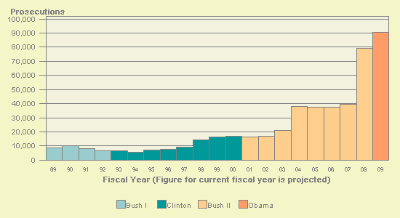
A couple of new studies demonstrate just how effective and massive these programs and operations have become. Both examining just one aspect of enforcement ...federal prosecutions for immigration related crimes ... which have increased 459% in the last ten years.

The Transactional Records Access Clearinghouse (TRAC) and Warren Institute at the University of California at Berkeley recently released reports highlighting the dramatic increase in federal immigration prosecutions and the link to Operation Streamline, a DHS program which mandates federal criminal prosecution of all persons caught crossing the border unlawfully.

The Warren Institute report highlights the impact of Operation Streamline on immigration enforcement and the TRAC report shows that federal immigration prosecutions rose to record levels during fiscal year 2009 and how a shift in priorities has created the largest number of federal immigration prosecutions of non-violent border crossers ever.

The latest available data from the Justice Department show that during the first nine months of FY 2009 the government reported 67,994 new immigration prosecutions. If this activity continues at the same pace, the annual total of prosecutions will be 90,659 for this fiscal year. According to the case-by-case information analyzed by the Transactional Records Access Clearinghouse (TRAC), this estimate is up 14.1 percent over the past fiscal year when the number of prosecutions totaled 79,431.


Number Year-to-date67,994
Percent Change from previous year14.1
Percent Change from 5 years ago139
Percent Change from 10 years ago459
Percent Change from 20 years ago973


The comparisons of the number of defendants charged with immigration-related offenses are based on case-by-case information obtained by TRAC under the Freedom of Information Act from the Executive Office for United States Attorneys

Compared to five years ago when there were 37,884, the estimate of FY 2009 prosecutions of this type is up 139 percent. Prosecutions over the past year are much higher than they were ten years ago. Overall, the data show that prosecutions of this type are up 459 percent from the level of 16,219 reported in 1999 and up 973 percent from the level of 8,448 reported in 1989.
TRAC


While the TRAK report looked at record increase in all federal immigration prosecutions, the Warren Institute looked at the effect of just one Operation along the US/ Mexico border: Operation Streamline.

The Department of Homeland Security(DHS) began implementing OperationStreamline along the U.S.-Mexico border in2005. The program has fundamentally transformed DHS’s border enforcement practices. Before Operation Streamline began, DHSBorder Patrol agents voluntarily returned first-time border crossers to their home countries or detained them and formally removed them from the United States through the civil immigration system. The U.S. Attorney’s Office reserved criminal prosecution for migrants with criminal records and for those who made repeated attempts to cross the border. Operation Streamline removed that prosecutorial discretion, requiring the criminal prosecution of all undocumented border crossers, regardless of their history.

Operation Streamline has generated unprecedented caseloads in eight of the eleven federal district courts along the border, straining the resources of judges, U.S. attorneys, defense attorneys, U.S. Marshals, and court personnel. The program’s voluminous prosecutions have forced many courts to cut procedural corners. Magistrate judges conduct en masse hearings, during which as many as 80 defendants plead guilty at a time, depriving migrants of due process. Indeed, in December 2009, the U.S. Court of Appeals for the Ninth Circuit held that Operation Streamline’s en masse plea hearings in Tucson, Arizona violate federal law.By focusing court and law enforcement resources on the prosecution of first-time entrants, Operation Streamline also diverts attention away from fighting drug smuggling, human trafficking, and other crimes that create border violence
Assembly-Line Justice: A Review of Operation Streamline


  • Immigration prosecutions make up 54 percent of all federal criminal prosecutions. The most prosecuted federal immigration crimes in FY 2009 were for immigrants caught entering the United States at an improper time or place, totaling approximately 40,000. Between 2002 and 2008, prosecutions for first time illegal entry in border district courts increased 330% from 12,411 to 53,697

  • Illegal reentry of a deported alien accounted for nearly 22,000 prosecutions in FY 2009.

  • In contrast, potential smuggling charges were brought less frequently. TRAC found 2,980 prosecutions for bringing in and harboring certain aliens, and 106 prosecutions for aiding and abetting an illegal entry.

  • 85% of the prosecutions originated with Customs and Border Protection (CBP). Immigration and Customs Enforcement (ICE) accounted for 13% of the prosecutions.

  • Before 2005, CBP voluntarily returned first time border crossers or formally removed them through the civil system. Federal prosecutions were used almost exclusively for individuals with previous criminal records or repeat crossers. Operation Streamline --instituted in Del Rio, Texas in 2005 and later expanded to other areas -- shifted this practice by eliminating prosecutorial discretion and requiring that all unlawful border crossers be prosecuted in federal criminal court and imprisoned if convicted, regardless of their immigration history.15 Those who are caught entering the U.S. illegally for the first time are prosecuted for misdemeanors punishable by up to 6 months in prison.

  • Most Operation Streamline defendants are migrants from Mexico or Central America who have no prior criminal convictions and who have attempted to cross the border in search of work or to reunite with family in the United States.

  • The link between Operation Streamline and federal prosecution rates can be seen in the judicial districts near these enforcement zones. The Southern District of Texas prosecutes the most immigration crimes, with 23,000 in FY 2009, up 22.1% from FY 2008.1819 The District of Arizona was second with 16,477, up 39.7% from FY 2008.


If we add the fact that President Obama's proposed budget for 2011 includes additional increases in spending along the border and for interior enforcement it becomes obvious that the enforcement juggernaut has far from reached it's end.

So we must now ask ourselves ... when in fact will the border ever be "secure" enough?

We have long heard about the failures of 1986 and how if only the laws were enforced, then we could start to look at reforming the dysfunctional and broken system that only feeds the growing prison-industrial complex.

Well, the laws have been enforced.

There's been a nearly 1000% increase in immigration prosecutions since 1990. In 2009 alone, the U.S. government had held over 440,000 people in immigration custody – more than triple the number of people in detention just ten years ago - and deported 387,000 immigrant workers, the highest recorded number in U.S. history.

So, how much longer are the "sins" of 1986 to hang over everyone's heads? Is there some secret magic number that needs to be reached? Is it a 2000% or 3000% increase in prosecutions? One Million in detention or deported?

How large a price must be paid by immigrant communities before there is a remedy? How many more mothers must be separated from their children? How many families torn apart? Communities terrorized? How many more lives destroyed and futures taken away?

When will the down payment paid in suffering and sorrow be acknowledge ... and the promise of reform finally be honored.?

I think it's fair to say ...NOW!!!!!!

Read More...

Tuesday, February 2, 2010

The Raw Politics of Immigration Reform Should Lead to Legislation

There are numerous reasons why it would be wise for Washington to address the nation&'s failed immigration policies sooner rather than later and finally fix a system that no one on either end of the political spectrum believes is either functioning properly or serving the best interests of the people . Even though studies show that reforming immigration would be a boost to the economy at a time when it could surely use one, and human rights issues make reforming the system a moral imperative, many still believe that it's an issue too politically hot to handle.

Since nothing yet has provided the requisite motivation to those in Washington to move forward and tackle reform, it&'s time to start to look at it through a prism they can understand: Pure Machiavellian political calculation.

As has been rightly pointed out, reform cannot be a one party affair, and to get it accomplished there will have to be some reaching across the aisle and bipartisan compromise. Yet, given the current polarization in Washington, accomplishing such a task might seem to be impossible ... until of course we look at the alternatives.

It's quite obvious at this point that the American electorate is furious, with discontent across the political spectrum from left to right ... and more importantly the middle.

Confidence in Washington is approaching record lows with few having faith in elected officials to fix the serious problems facing the nation. 60% believe that the country's heading in the wrong direction. The elation of 2008 that a new era of change was upon us, and that the gridlock and partisan politics of the past might finally give way to effective governance, has quickly given way to distrust and cynicism.

Those from both parties now face an angry public more intent than ever to throw the bums out of office.

On the right, all but the most hard-core reactionary conservatives face challenges from the far-right extremes of their party. In Florida, one-time party favorite, Charlie Crist, looks like toast with teabagger Marco Rubio crushing him in the polls. Former standard bearer, John McCain, daily tries to distance himself from every past position he's ever held in hopes of warding off primary defeat. In NY23 the pitchfork and torch crowd lunched a successful coup, driving out the party favorite, ultimately handing the election to the opposition.

Fueled by the vitriolic rants of Glenn Beck or Rush Limbaugh, and living in an information isolation-bubble created by the FOX News noise machine, the angry mob has become emboldened and threatens to tear their party apart in a frenzy of fratricide.

On the left, the inability of the administration and its Congressional allies to deliver on their promise to usher in a new era in Washington has had a different effect. While the right-wing base is energized, the historic coalition that Obama built of youth, ethnic voters, and independents is withering away due to ambivalence and disillusion.

As we saw in NJ, VA, and most recently in MA, the Obama coalition simply failed to show up at the polls. And those that did were the disenchanted independents still looking for change who thought they'd find it in a pick-up truck driving, faux-populist, "independent Republican."

But as much as both parties are having problems with their respective bases, it's the magic 40+% unaffiliated voters who now create the most problems for both.

They're sick and tired of the partisan bickering, political posturing, and gridlock that prevail in Washington.

They're scared. They see a faltering economy, endless wars, high unemployment and an uncertain future, and they want something done.

They watched the protracted political sausage making that mired down the health care debate, the convoluted economics of the stimulus bill, and the daily theater of the absurd as obstructionist Republicans did everything in their power to derail an Obama presidency ... and they're fed up.

They want to clean house, and few incumbents will be safe from their wrath.

Realizing this, both parties have telegraphed their electoral strategies.

Republicans will attempt to run as outsiders, trying to convince voters that somehow Washington careerists are in fact, fresh faces with new ideas, all along stalling and trying their damnedest to prevent anything from getting accomplished that might make Obama look good.

The Democrats, with Obama in the lead, will hammer away on those very same stall tactics and try to lay the blame for all the gridlock and partisan rancor in Washington at the Republican's feet.

But both these plans contain Achilles heels that could doom them to failure.

As a new poll just released by non-partisan independent pollster Research 2000 of over 2,000 self-identified Republicans shows, the base has moved so far to the extreme they could become toxic for incumbents in all but the reddest of red states. Particularly given Obama's still very high personal popularity.

  • 63% think Obama is a socialist
  • only 42% believe he was born in US
  • 39% want Obama impeached.
  • 53% think Sarah Palin is more qualified to be president than Obama
  • 23% want to secede from US
  • 24% believe Barack Obama wants the terrorists to win
  • 31% believe Barack Obama is a racist who hates White people
  • 73% think gay men and women shouldn't be allowed to teach in public schools
  • 31% want contraceptives outlawed


In order to paint themselves as outsiders, Republicans, who make up only 22.5% the electorate, will be forced to embrace those in their party who have already firmly staked out that ground ... the teabaggers and birthers who flocked to last summers town halls to "take their country back."

Having to cater to this constituency not only to ward off primary challenges or raise funds, but to appear "mavericky" enough, Republicans run the risk of alienating the independents and moderates essential to winning general elections. In many ways, in order to remain viable in general elections dominated by centrist independents, Republicans will need to distance themselves from what now appears to be the public face of their party.

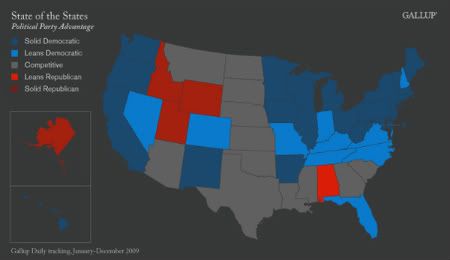
A recent Gallup poll shows just how risky catering to the base could be. It's still a very blue country:

Overall, 49% of Americans in 2009 identified as Democrats or said they were independent but leaned to the Democratic Party, while 41% identified as Republicans or were Republican-leaning independents In total, 23 states plus the District of Columbia can be classified as solidly Democratic, with a 10 percentage-point or greater advantage in party affiliation in favor of the Democrats. This includes most of the Northeast and mid-Atlantic regions, most of the Great Lakes region, and the Pacific Coast.

Another 10 states can be considered Democratic leaning, in which the state's Democratic supporters outnumber Republican supporters by at least 5 percentage points but less than 10 points. These are Missouri, Kentucky, North Carolina, Florida, New Hampshire, Virginia, Colorado, Nevada, Indiana, and Tennessee.

Four states are solidly Republican, with a better than 10-point advantage in Republican affiliation -- Wyoming, Utah, Alaska, and Idaho. Alabama qualifies as the lone Republican-leaning state, with a 6-point advantage in Republican affiliation.

That leaves 12 states that are competitive, with less than a 5-point advantage for either party. Among these 13 states, 6 tilt in a Republican direction: Montana, Nebraska, Mississippi, Texas, North Dakota, and Kansas. Six tilt toward the Democratic Party: Georgia, South Dakota, Louisiana, Arizona, Oklahoma, and South Carolina.

Gallup


Republicans would need to replicate their "Massachusetts Miracle" across the electoral map in order to succeed … something far easier to crow about, than do.

For Democrats, the "blame it all on the Republicans" strategy is risky also. Congressional Democrats' approval ratings are in the toilet, only slightly higher than the Republicans:

PARTYAPPROVEDISAPPROVE
CONGRESSIONAL DEMS:3759
CONGRESSIONAL GOP:2163


This low standing in most part due to their perceived inability to get anything accomplished and getting mired down in the toxic partisan bickering that has marked this Congress.

Attempting now to point fingers at the opposition is a dicey proposition.

With all his substantial personal charms and political skills, even Obama would be walking the fine line between criticizing partisanship and engaging in it… A risky move even in a far less volatile political climate.

It's even riskier when attempted by far less well-liked and politically talented Democrats who run the risk of sounding like they're just making shrill excuses for their bad behavior.

But perhaps both parties would be better served if they actually just did the people's bidding and found a way to get something done. It would serve them well to roll up their sleeves and put partisan political gamesmanship aside long enough to get at least one piece of major legislation passed this session. It would be in both their political best interests.

Republican's would be able to defuse Democratic attacks about being obstructionists and have some claim to the middle at a time when the extreme base of the party appears to be anything but, and Democrats would prove they can get something done.

It's for this reason that the time to address immigration reform has come.

  • It's the kind of "tough issue" that polls have constantly shown the American people want tackled.
  • It has the support of a broad coalition that includes labor, business, and faith-based organizations.
  • Good arguments have be made for the economic benefits of enacting reform
  • The demographics work…neither party can survive long-term without the Latino and New American vote
  • Polling shows the majority of Americans favor reform
  • It's received bi-partisan support in the past
  • Restrictionist campaigns have consistently failed at the polls


From a purely political point of view this seems to be a no-brainer.


-----------------


SOME USEFUL INFO ON REFORM

1. Fact Sheet: How Immigration Reform Would Help the Economy
by the Center for American Progress

A fact sheet summarizing recent research on the benefits of legalization.

2. “The Economic Benefits of Comprehensive Immigration Reform”
By Raul Hinojosa for the Center for American Progress and the Immigration Policy Center

This report finds that comprehensive immigration reform that includes a legalization program for unauthorized immigrants and enables a future flow of legal workers would result in a large economic benefit—a cumulative $1.5 trillion in added U.S. gross domestic product over 10 years. In stark contrast, a deportation-only policy would result in a loss of $2.6 trillion in GDP over 10 years.

3. Restriction or Legalization? Measuring the Economic Benefits of Immigration Reform
by Peter B. Dixon and Maureen T. Rimmer for the CATO Institute

A report which finds that legalization of low-skilled immigrant workers would yield significant income gains for American workers and households. It would also allow immigrants to have higher productivity and create more openings for Americans in higherskilled occupations. The positive impact for U.S. households of legalization under an optimal visa tax would be 1.27 percent of GDP or $180 billion. 

4. The Economics of Immigration Reform: Legalizing Undocumented Workers a Key to Economic Recovery
by the Immigration Policy Center

April 2009 analysis of how legalization would protect our workers, raise wages, and get our economy moving again.

5. Policy Brief: New Immigration Reform Bill Supports America’s Middle Class
Drum Major Institute for Public Policy

A Legislative Analysis of the Comprehensive Immigration Reform for America’s Security and Prosperity Act of 2009(H.R. 4321) sponsored by Representative Solomon Ortiz (D-TX), Rep. Luis Gutierrez (D-IL) and 92other co-sponsors

6. The Labor Movement’s Framework for Comprehensive Immigration Reform
AFL-CIO and Change to Win

Announced in April 2009, this is the labor movements unified framework for comprehensive immigration reform.  This framework is a critical sign of support for the Administration and Congress to address immigration reform -- and to ensure that it remains a priority on the legislative calendar. It is also an important sign that immigration reform is an important part of economic recovery.

7. Loving Thy Neighbor: Immigration Reform and Communities of Faith
by Sam Fulwood III for the Center for American Progress

This report documents how  a wide range of faith groups are showing a new, unexpected, and grassroots-led social activism that’s rooted in theological and moral ground. While loud and shrill anti-immigrant voices dominate much of the media attention regarding immigrants and especially the undocumented, faith community activists are caring and praying in the shadows of public attention.

8. The Role of Local Police: Striking a Balance Between Immigration Enforcement and Civil Liberties
By Anita Khashu for the Police Executive Research Foundation

While this report focuses on and provides critique of the role of local police and immigration enforcement, one of the major findings is the need for enactment of comprehensive immigration reform legislation.


Read More...