










Showing posts with label immigrant rights. Show all posts

Thursday, February 4, 2010

The down payment's been paid, when will the goods to be delivered?

For years, all we've heard from those opposed to immigration and immigration reform is that until the government could prove that it was "serious" about border security and enforcement, no meaningful discussion of immigration reform was going to take place. The mantra of "we can't reform immigration laws until we control immigration, and we can't control immigration unless we control our borders" has been the guiding principle behind every obstructionist attempt to derail systematic reform. And attempts to appease restrictionists, by adopting "enforcement first" policies" have become the accepted framework from which all discussions were forced to start.

But most of those working for positive change have known all along that "enforcement first" is just a catch-22. It's an ever-moving target that was never intended to be reached. The ultimate goal of those opposed to reform has never been to "control" immigration...but rather to end it.

Yet despite these obvious facts, both the Bush and Obama administrations dived head first into the enforcement waters.

The last few years have been marked by hugely escalating enforcement budgets, increased apprehension, deportation and detention, increased use of local law enforcement, raids, and employer audits.

Programs like "Operation Streamline", "Secure Communities", "287G", "Operation Community Shield", and "Rapid REPEAT", (to name a few) have all been ramped up to locate, and remove the undocumented population. And while the human suffering caused by these and other programs has been immeasurable, no one can deny their effect on both illegal entry and presence.

So the question now becomes; At what point can we say enough is enough?

At what point will the forces that demand strict enforcement before any discussion of reform can begin, be content? Immigrant communities across this nation have paid the price, they've made their down payment on reform ...when do they finally see something in return?

A couple of new studies demonstrate just how effective and massive these programs and operations have become. Both examining just one aspect of enforcement ...federal prosecutions for immigration related crimes ... which have increased 459% in the last ten years.

The Transactional Records Access Clearinghouse (TRAC) and Warren Institute at the University of California at Berkeley recently released reports highlighting the dramatic increase in federal immigration prosecutions and the link to Operation Streamline, a DHS program which mandates federal criminal prosecution of all persons caught crossing the border unlawfully.

The Warren Institute report highlights the impact of Operation Streamline on immigration enforcement and the TRAC report shows that federal immigration prosecutions rose to record levels during fiscal year 2009 and how a shift in priorities has created the largest number of federal immigration prosecutions of non-violent border crossers ever.

The latest available data from the Justice Department show that during the first nine months of FY 2009 the government reported 67,994 new immigration prosecutions. If this activity continues at the same pace, the annual total of prosecutions will be 90,659 for this fiscal year. According to the case-by-case information analyzed by the Transactional Records Access Clearinghouse (TRAC), this estimate is up 14.1 percent over the past fiscal year when the number of prosecutions totaled 79,431.


Number Year-to-date67,994
Percent Change from previous year14.1
Percent Change from 5 years ago139
Percent Change from 10 years ago459
Percent Change from 20 years ago973


The comparisons of the number of defendants charged with immigration-related offenses are based on case-by-case information obtained by TRAC under the Freedom of Information Act from the Executive Office for United States Attorneys

Compared to five years ago when there were 37,884, the estimate of FY 2009 prosecutions of this type is up 139 percent. Prosecutions over the past year are much higher than they were ten years ago. Overall, the data show that prosecutions of this type are up 459 percent from the level of 16,219 reported in 1999 and up 973 percent from the level of 8,448 reported in 1989.
TRAC
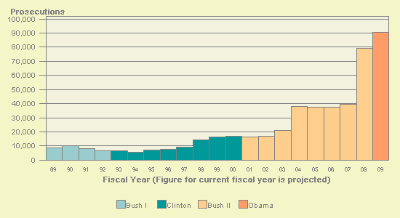


While the TRAK report looked at record increase in all federal immigration prosecutions, the Warren Institute looked at the effect of just one Operation along the US/ Mexico border: Operation Streamline.

The Department of Homeland Security(DHS) began implementing OperationStreamline along the U.S.-Mexico border in2005. The program has fundamentally transformed DHS’s border enforcement practices. Before Operation Streamline began, DHSBorder Patrol agents voluntarily returned first-time border crossers to their home countries or detained them and formally removed them from the United States through the civil immigration system. The U.S. Attorney’s Office reserved criminal prosecution for migrants with criminal records and for those who made repeated attempts to cross the border. Operation Streamline removed that prosecutorial discretion, requiring the criminal prosecution of all undocumented border crossers, regardless of their history.

Operation Streamline has generated unprecedented caseloads in eight of the eleven federal district courts along the border, straining the resources of judges, U.S. attorneys, defense attorneys, U.S. Marshals, and court personnel. The program’s voluminous prosecutions have forced many courts to cut procedural corners. Magistrate judges conduct en masse hearings, during which as many as 80 defendants plead guilty at a time, depriving migrants of due process. Indeed, in December 2009, the U.S. Court of Appeals for the Ninth Circuit held that Operation Streamline’s en masse plea hearings in Tucson, Arizona violate federal law.By focusing court and law enforcement resources on the prosecution of first-time entrants, Operation Streamline also diverts attention away from fighting drug smuggling, human trafficking, and other crimes that create border violence
Assembly-Line Justice: A Review of Operation Streamline


  • Immigration prosecutions make up 54 percent of all federal criminal prosecutions. The most prosecuted federal immigration crimes in FY 2009 were for immigrants caught entering the United States at an improper time or place, totaling approximately 40,000. Between 2002 and 2008, prosecutions for first time illegal entry in border district courts increased 330% from 12,411 to 53,697

  • Illegal reentry of a deported alien accounted for nearly 22,000 prosecutions in FY 2009.

  • In contrast, potential smuggling charges were brought less frequently. TRAC found 2,980 prosecutions for bringing in and harboring certain aliens, and 106 prosecutions for aiding and abetting an illegal entry.

  • 85% of the prosecutions originated with Customs and Border Protection (CBP). Immigration and Customs Enforcement (ICE) accounted for 13% of the prosecutions.

  • Before 2005, CBP voluntarily returned first time border crossers or formally removed them through the civil system. Federal prosecutions were used almost exclusively for individuals with previous criminal records or repeat crossers. Operation Streamline --instituted in Del Rio, Texas in 2005 and later expanded to other areas -- shifted this practice by eliminating prosecutorial discretion and requiring that all unlawful border crossers be prosecuted in federal criminal court and imprisoned if convicted, regardless of their immigration history.15 Those who are caught entering the U.S. illegally for the first time are prosecuted for misdemeanors punishable by up to 6 months in prison.

  • Most Operation Streamline defendants are migrants from Mexico or Central America who have no prior criminal convictions and who have attempted to cross the border in search of work or to reunite with family in the United States.

  • The link between Operation Streamline and federal prosecution rates can be seen in the judicial districts near these enforcement zones. The Southern District of Texas prosecutes the most immigration crimes, with 23,000 in FY 2009, up 22.1% from FY 2008.1819 The District of Arizona was second with 16,477, up 39.7% from FY 2008.


If we add the fact that President Obama's proposed budget for 2011 includes additional increases in spending along the border and for interior enforcement it becomes obvious that the enforcement juggernaut has far from reached it's end.

So we must now ask ourselves ... when in fact will the border ever be "secure" enough?

We have long heard about the failures of 1986 and how if only the laws were enforced, then we could start to look at reforming the dysfunctional and broken system that only feeds the growing prison-industrial complex.

Well, the laws have been enforced.

There's been a nearly 1000% increase in immigration prosecutions since 1990. In 2009 alone, the U.S. government had held over 440,000 people in immigration custody – more than triple the number of people in detention just ten years ago - and deported 387,000 immigrant workers, the highest recorded number in U.S. history.

So, how much longer are the "sins" of 1986 to hang over everyone's heads? Is there some secret magic number that needs to be reached? Is it a 2000% or 3000% increase in prosecutions? One Million in detention or deported?

How large a price must be paid by immigrant communities before there is a remedy? How many more mothers must be separated from their children? How many families torn apart? Communities terrorized? How many more lives destroyed and futures taken away?

When will the down payment paid in suffering and sorrow be acknowledge ... and the promise of reform finally be honored.?

I think it's fair to say ...NOW!!!!!!

Read More...

Tuesday, June 3, 2008

ICE: Keeping America safe from High School valedictorians

Arthur Mkoyan's 4.0 grade-point average has made him a valedictorian at Bullard High School in Fresno and qualified him to enter one of the state's top universities.

But while his classmates look forward to dorm food and college courses this fall, Arthur Mkoyan may not make it.

He is being deported.

Arthur, 17, and his mother have been ordered out of the country. By late June, they may be headed to Armenia.

Arthur hasn't seen Armenia since he was 2, and he doesn't want to return. The thin, rather shy teenager doesn't speak Armenian and barely understands the language when it's spoken to him.

"Hopefully, I can somehow stay here and continue my studies here," he said. "It would be hard if I go back."

The family fled from the old Soviet Union and has been seeking asylum since 1992. The appeals ran out this year.

He and his mother, who did not want to be identified for fear of losing her job and income she needs, were given an extension to June 20 so Arthur could join his class at the ceremony, said Virginia Kice, a spokeswoman for U.S. Immigration and Customs Enforcement.

… Arthur's father, Ruben Mkoian, ran a general store and worked as a police officer in the then-Soviet Republic of Armenia, where he was threatened by independence supporters as the Soviet Union was breaking up, Arthur's mother said. His store was broken into and the family home was burned down, she said.

Seeking a safer life, Mkoian left for Fresno in December 1991 and soon applied for political asylum. Mkoian, who spells his name differently from his son, chose Fresno because he had a close friend here.

Arthur and his mother spent three years in Russia before joining Mkoian in Fresno in 1995.

Mkoian worked for a carpet business and later as a truck driver. But winning asylum turned out to be difficult. Asylum seekers must prove they would suffer severe persecution if they return to their country.

Mkoian's asylum application, which included his family, ultimately was rejected. He appealed the decision to the 9th Circuit Court of Appeals in San Francisco, which ruled against him in January.

Immigration officers picked up Mkoian, now 46, in April at his Fresno home, according to his family. He is now in a detention center in Arizona.

FresnoBee


This is just another case, in a long list, for why the failure of Congress to pass the DREAM Act was so important. This young man should have been heading off to college this fall to further his already successful academic career … instead he'll be shipped off to a country he doesn't even know and an uncertain future.

Read More...

Monday, March 17, 2008

For Eddie on St Patrick's Day

Today will mark the fourth St Patrick's day to pass since I first started writing about immigration reform and migrant rights. And as any blogger who's been doing this for any amount of time can tell you, blog years are like dog years, and over three years in blogtopia can seem like a half a lifetime.

Two years ago, in 2006, this day had brought great promise.

The Kennedy-McCain Bill was making its way through the Senate, and the first wave of the great immigration rallies were but only days away. Millions, including Irish and other immigrants from around the world, would take to the streets and demand meaningful reform.

We all thought change would surely come….yet it hasn't.

I'm not Irish, and don't partake in the revelry that marks the day. It usually passed for me rather uneventfully. But once I started blogging about immigration, in some strange way, it's become a milestone that marks the passage of time.

Somewhere today in the mainstream media, or in the blogosphere, there will be a story about what's become an annual rite of spring that takes place every St Patrick's Day.

At a parade in New York, or Boston, or in the halls of Congress in Washington, some political leader will pose with members of the Irish Lobby for Immigration Reform , or some other advocacy group, and make promises they have no intention of keeping.


Donning their best green ties, and an eagerness to pander on the day when "everyone's Irish," even the most ardent anti-immigration hawk will promise to "look into the Irish immigration situation." ... but of course they won't.

So to mark this day I have chosen not to write the obligatory St Patrick's Day "Politicians Promise" post … instead I offer a story first published in the Boston Globe this past January.

I apologize in advance to the gods of fair use, but Eddie Treacy's story is too compelling, and Kevin Cullen's writing too beautiful to chop it up and place it in those little blockquote boxes … so I present it in its entirety:

A Toast to an Irishman

Eddie Treacy lived in the shadows and died in his bed, the covers pulled up, his lungs full of fluid.

He was 33 years old, and there is no other way to say this: He died too young.

He came to Dorchester eight years ago from Athenry, in County Galway, part of what could be the last great wave of the young Irish to come here.

Boston is still Irish enough for a guy like Eddie Treacy to fit in. There's always enough work, and there are Gaelic games in Canton on the weekends and fresh brown bread every day at Greenhills Bakery in Adams Village.

Eddie was a master carpenter and made a decent living. For a young man, he was old school, using a simple tool called a square.

Eddie only needed one measurement for a job. Others would punch away at calculators, but Eddie would do the calculations in his head, and hand off the wood, cut precisely, like a diamond.

After a day's work, Eddie would make his way to the Eire Pub for a few jars. If the stool next to his great pal, Muldoon, was open, he would take it.

"How's Mul?" Eddie would ask.

"How's Eddie?" Muldoon would ask back.

And then they would silently watch the news on the TV set over the head of Martin Nicholson, the barman. With Eddie, there was no need for long yarns or running commentary.

Eddie was a rare Irishman, in that he was a great listener, not a great talker. If he agreed with you, he would nod, almost imperceptibly. If he thought you were full of it, he would raise an eyebrow, a silent indictment.

Like other illegal immigrants, he wanted to legalize his residency. He would have paid anything, done anything. But there was no way.

He thought about going home, as his brother Michael did, not long after Eddie first came here.

But Eddie liked it here, so he stayed on, kept his head down.

He didn't ask for much. Once, he told Muldoon he would be happy if he died in his own bed and they played "The Fields of Athenry" at his funeral. They both laughed, because young men don't think they will ever die.

Eddie died in his own bed. We will never know if it was stubborn pride or a fear of being deported that kept him from going to a hospital to treat the pneumonia that killed him. Maybe he just didn't realize how sick he was.

Gerry Treacy hadn't seen his brother in eight years, and when he finally did, Eddie was lying in a casket inside the Keaney Funeral Home on Dot Ave.

"He was a quiet lad," Gerry Treacy was saying, as he and Michael prepared to bring their brother home. "He liked the simple pleasures."

Brendan McCann, a senior at BC High, stood near the altar and played "The Fields of Athenry" on his fiddle as they wheeled Eddie Treacy's casket down the aisle of St. Brendan's Church.

All around the church, there were images of another carpenter who died at 33, nearly 2,000 years ago, another carpenter who some people dismissed as a criminal.

After Mass, about 200 people posed on the front steps of the church for a photo to send back to Eddie's mother, Ann, so she would know that Eddie mattered here. Many of the young men standing there had given up a day's wages to pay their respects.

Then everybody went to Sonny's, the pub that sponsored the Father Tom Burke hurling teams Eddie played for and managed.

Muldoon raised a glass to his friend.

"We'll never see the likes of him again," he said.

On Monday night, as President Bush told the nation that we need to find "a sensible and humane way to deal with people here illegally," Eddie Treacy's body was in the cargo hold of Aer Lingus Flight 132, somewhere over the Atlantic, heading home.

Eddie Treacy was buried today, where he wanted to be, in the fields of Athenry.


Boston Globe, Jan 31, 2008


So to Patrick Joseph Buchanan, William James O'Reilly, Sean Hannity and all the others whose tribal worldviews and reptilian brains have so poisoned this debate with the worst kind of bigotry and divisiveness - I wish you a happy St Patrick's Day.

But, I leave you with this thought as you revel in your immigrant past and enjoy your native foods and rituals:

Immigrants really do come in all colors of the rainbow from the deepest black to the whitest white. And whether it's Eddie Treacy shipped back in a box in the cargo hold of an Aer Lingus flight, or Edith Rodreguez losing her infant son to the desert heat, or Antonio Torres Jimenez perishing as he tried to return to his family, or Jesus Abran Buenrostro frantically trying to lead rescuers to his already dead mother in the Arizona desert …. all their blood is on your hands ... all their suffering should be on your conscience.

So have a happy St Patrick's Day, and as you do, just remember that each and every day, another immigrant dies in the shadows because of you.

Read More...

Thursday, February 28, 2008

Time for a Reality Check

These have been heady times for those in the migrant-rights movement.

Starting back in November with the failure of anti-immigrant campaigns to resonate with the electorate, an apparent sea change was assumed to be taking place. Much ink and many pixels were expended speculating on the presumed death of the "immigration issue" as a motivating force in the US political scene.

From the left, the progressive blogosphere finally found the courage to voice pro-immigrant positions after nearly two years of bowing to the conventional wisdom coming out of Washington that immigration was a "third rail" not to be touched.

From the right, pundits and the chattering classes warned that to continue stoking the flames of anti-immigrant sentiments was like beating the proverbial dead horse, and would yield no rewards.

Over the following months things looked even brighter.

After starting a presidential campaign where each candidate tried their best to "out Tancredo, Tancredo" on immigration matters, one by one the Republican contenders who put their eggs in the anti-immigrant basket fell by the wayside. In the end, the only three standing were the party's only bona fide pro-immigrant candidate, and two candidates whose recent conversion to the anti-immigrant camp was questionable at best. With McCain's presumptive triumph, even Huckabee's and Romney's road to Damascus conversion to Tancredoism seems to have hurt them far more than it helped.

On the Democratic side, the top contenders were quick to finally pick up on these subtle cues - once it became obvious to even the least politically savvy that they need not fear the immigration boogieman.

To his credit, Mr. Obama was early to the pro-migrant party, and supported driver's licenses for undocumented immigrants even as his opponent waffled and tried to triangulate her position due to the nagging "third rail" fear that so haunted the DLC. He also came out early and pledged to take up comprehensive reform within the first one hundred days of his administration and voiced strong support for the DREAM Act. But lately, even the ever cautious Mrs. Clinton has spoken out against immigration raids, and promised to curtail them, voiced tepid disapproval of the great wall project, and vowed to join Obama's pledge to give the nation real reform within one hundred days of taking office.

All of this has been music to the ears of those in the pro-migrant movement.

In both the tradition media and blogtopia, pro-migrant voices have started to break through.

To varying degrees, both NCLR's Janet Murguia and "Democracy Now's" Amy Goodman and Juan Gonzalez managed to issue live smack-downs on anti-immigrant powerhouse, Lou Dobb ( In Murguia's case, on Lou's own show). They called him out not only for his misleading and unbalanced presentation of the issue, but also his embrace of some of the most virulent racists engaged in the anti-immigrant movement. If this was not clear evidence that David could smite the anti-immigrant Goliath …. nothing was.

On the web, pro-migrant, Latino, and human-rights blogs and web sites are proliferating and finally gaining long deserved attention and recognition. Outreach and cooperation between the traditional pro-immigrant activist organizations has reached a near fever pitch as they attempt to put together the large-scale, organized, effort that will be essential in moving meaningful reform in the new, more immigrant-friendly, atmosphere all anticipate is just around the corner.

At least that's what we've all been telling each other for the last few months

But just today, once again reality strikes us in the face:

House OKs seizing vehicles from illegal immigrants

A bill that would allow police to seize cars from illegal immigrants was approved by the House Thursday.

Bill sponsor Rep. James Mills (R-Gainesville) repeatedly told House members Thursday the measure would protect Georgia citizens from the "epidemic" of illegal immigration. "The state of Georgia's door is being kicked down," Mills said. Immigrants are coming from "Iraq, Iran, Irania(sic), Jordan. We don't know where they're from," Mills said.

The measure passed 104 to 51, and will move to the Senate for consideration.

The bill would allow police to seize any vehicle involved in a traffic violation or accident if it's driven by an illegal immigrant. That includes rented and leased vehicles if the owner knew, or should have known, the driver was an illegal immigrant. It also includes bank-owned cars if the interest-holder actually knew the driver was an illegal immigrant.

The bill prompted a healthy floor debate. Some legislators asked how police would be able to determine whether a driver was an illegal immigrant during a traffic stop. Some wondered if it would create an atmosphere for racial profiling of drivers who police think might be illegal immigrants.

The legislation is part of a package of about 10 Republican proposals introduced this legislative session aimed at discouraging illegal immigration in Georgia.

AJC


Week after week - month after month - states and municipalities around the country take up similar anti-immigrant measures. And with each one passed, the lives of millions of people are changed - undocumented migrants, legal residents, and anyone else who just happens to look "foreign" or rolls their r's just a little too prominently when stopped at a traffic stop, applies for a job, or tries to rent an apartment.

"The legislation is part of a package of about 10 Republican proposals introduced this legislative session aimed at discouraging illegal immigration in Georgia."


And herein lays the problem.

In some ways we have deluded ourselves.

By focusing on what seems to be the "big picture" of the failure of anti-immigrant policies on the national stage, we have lost sight of the most important fact.

As the late Tip O'Neil pointed out …All politics is local….and when it comes to immigration and migrant issues, it's on the local level that much of this battle will need to be fought.

Yet, as a new study shows, it is not the economics or demographics of a given state or city that will determine how rabidly anti-immigrant it's laws and ordinances will be …. It's what political party controls it.

Our analysis suggests that the restrictionist responses of local governments to undocumented immigration is largely unrelated to demographic pressures—whether it be the growth of recent immigrants, or the proportion of Spanish-dominant households. They are also unrelated to the political empowerment of Latinos, as places with large proportions of Latino residents and citizens are no more or no less likely to propose legislation whether it be restrictionist or pro-immigrant. Instead, we find that political factors are more important, most notably partisan composition and the politicization of national immigration reform legislation at the local level.

…One of the strongest explanations for restrictionist versus “pro-immigrant” proposals is the proportion of Republicans and Democrats in the county. Controlling for demographic characteristics, Republican areas are twice as likely to propose restrictionist ordinances, and half as likely to propose “pro-immigrant” ones.

Even stronger effects can be found for the actual passage of such legislation. Other factors, such as the growth of the Latino population and the size of linguistically-isolated Spanish-speaking households, were not associated with a greater likelihood of proposing or passing restrictionist legislation. Thus, demographic factors are not as important as political factors in accounting for ordinances passed by local governments related to unauthorized immigration, either pro or con.


Cities in Republican areas are about twice as likely as those in Democratic areas to propose restrictionist legislation, and four times as likely to have passed such measures. On the passage of pro-immigrant legislation, Republican areas are about half as likely to consider or pass such measures (another way to say this is that Democrat areas are about twice as likely as Republican areas to consider and pass pro-immigrant measures).

Immigration Policies Go Local: The Varying Responses Of Local Governments To Undocumented Immigration


So while we have been working hard to change the hearts and minds of the US public, trying to counter the lies and misinformation proliferated by the anti-immigrant right, it comes down to mere politics as to whether the lives of millions are better or worse.

Of course, on the grand scale, we've always known the true enemy.

From October of 2005 when Frank Luntz first published "Respect for the Law & Economic Fairness: Illegal Immigration Prevention" and laid down the Republican battle plan for its anti-immigrant campaign, the handwriting's been on the wall.

This has always been a debate rooted in political machinations and calculations. It plays upon the fear, racism and bigotry that permeate the US collective psyche …but it's not organic, springing from the roots of bigotry and discontent …but rather it's been manufactured and nurtured by one political party to be used as a weapon against the other by feeding upon the worst instincts of the American people and appealing to their inner demons rather than better angles.

Less than two years after Luntz's blueprint was published, the plan was in full effect.

As of July 2, 2007, no fewer than 1404 pieces of legislation related to immigrants and immigration had been introduced among the 50 state legislatures. Of these bills, 182 bills became law in 43 states. Four bills have been vetoed by the Governor.

State legislators have introduced roughly two and a half times more bills in 2007 than in 2006. The number of enactments from 2006 (84) has more than doubled to 170 in 2007.

Several states are still in session so there could be additional legislation related to immigrants later this year.

NCSL


Yet for many of us, the disappointments and disillusionment with politics as usual have prevented us from recognizing this clear red/blue divide on this issue. Surely, the Democratic Party' own inability to seize the moral high ground on this issue has not made it easy to see the clear lines of demarcation. Additionally, red state Dems like Heath Shuler, who so readily work in the anti-immigrant camp, cloud the distinctions.

But, when taken as whole … the path forward is clear.

If the pro-migrant movement is to accomplish anything in the long-term, it must start to address the anti-immigrant movement at the local as well as the national level.

We cannot be satisfied by what appears to be progress on the national stage. We can't be satisfied with the apparent growth of a fledgling pro-migrant ground swell. We can't be content with our own efforts to build a movement, or mobilize or give voice to the Latino community, or engage labor, or reach out to progressives. We must start to truly put together a real new majority, a majority made up of all those groups and so many more.

We need a new majority that can take over the statehouses, city councils, and mayors offices across this country, and not just replace the occupants of 1600 Pennsylvania Ave, or Congress. We need a new majority that can reclaim the liberal, humanitarian ideals that once marked the Democratic Party … take it over, and then drag it, screaming and kicking, into a new 21st century.

Because if we don't ...we'll just get more of this:


Read More...

Monday, February 4, 2008

We Saw the Face of a New America

On May 1st 2006, millions took to the streets in cities and communities throughout the nation to finally have their voices heard.

Out from the shadows came the forgotten, the marginalized, the nameless, faceless, mass of humanity who toil daily in thankless jobs with little reward or recognition.

Those who had labored invisibly for years as they quietly provided a nation with prosperity of which they could never partake, took to the streets to say "no more". We will no longer be marginalized … We will no longer be demonized … We will not be criminalized ….We Are America.

That day, as pundits and politicians tried to grasp the seismic shift taking place, attempting to read the tea leaves of public opinion and formulate positions that would serve them politically, two men had the courage to do not what was safe or politically expedient …but rather, what was right.

One was an elder statesman, a lion in winter, who had long fought the great battles of his generation, battles for justice, and battles for equality. ….The other was a young man, just starting his political journey. A young man with a vision of the future based on hopes and dreams for a new America... An America that finally lived up to the principles and precepts on which it was founded. Those two men were Sen. Ted Kennedy and Sen. Barack Obama….The only two sitting Senators to take to the streets in solidarity with those who had too long been invisible.


Three days later Obama had this to say about his participation in the events in Chicago, and his vision for a new America:

On Monday, I traveled from D.C. to Chicago to witness a monumental event. There were 400,000 people marching on behalf of comprehensive immigration reform in this country. There were rallies all across the country but Chicago was one of the largest. I had the opportunity to speak to the people who were gathering at Union Park before they marched over to Grant Park. Four-hundred thousand people, mostly of Mexican origin, but large numbers of people from other countries - Nigerians and Pakistanis and Indians and Filipinos - people who've come to this country for the same reason that immigrants have been drawn to this country for generations: the notion that they can pursue and better life for themselves but, most importantly, for their children, if they work hard and apply themselves.

I think what we saw in those marches is the face of a new America. America is changing and we can't be threatened by it. We have to understand that we are going to be better off united than divided.

…to those who are fearful of these immigrants, in some cases because they have come to represent a loss of control for the country and its borders, I would just say to them that we can't have a country in which you have a servant class that is picking our lettuce or plucking our chickens or looking after our children or mowing our lawns but who never have the full rights and obligations of citizenship. That's just not the kind of country that I want to have my children grow up in and my hope is that over the coming months we can come up with the kind of comprehensive, thoughtful legislation that I think the Senate bill reflects and we can have strong border security, we can have employers do the right thing by hiring those who are here legally in some fashion, but that we also provide all those families, children, elderly people and teenagers that I saw in that amazing march on Monday the opportunity to be full members of the American community.

Barack Obama on Immigration Marches, May 4, 2006

Read More...

Thursday, December 6, 2007

"Illegal" Is Never a Noun


From Eric Haas of The Rockridge Institute comes this:

On the issue of immigration, politicians and much of the mainstream media are playing with our minds. By repeating the phrase "illegal immigrants," they're creating a misleading stereotype. It's inaccurate. And, it's distracting us from the real issue -- economic exploitation of all low-wage workers in the United States.

The Republicans did it in their YouTube debate on CNN. In the first 30 minutes, the Republicans repeatedly used the term "illegal immigrant" and spent the time sparring over which of them could treat them more harshly. Were the painters who worked on Romney's house and the low-wage workers in Giuliani's New York City really such a grave threat to America

CNN's John King used the term, too. And so did CNN's Wolf Blitzer and Campbell Brown in the most recent Democratic debate in Las Vegas. And, some of the Democratic candidates also used it, though Kucinich specifically refused ("There are no illegal human beings"). But he's in the minority. The term is everywhere in the press. You can find it in the Washington Post and in the New York Times, as well as the doubly derogatory term "illegal alien" in the Washington Times. They've all got "illegal" on the brain.

Branding people with the Scarlet "I" creates a fearful stigma. The vast majority of immigrants, whatever their legal status, are law-abiding members of society. Yet, the "illegal" description is so pervasive that it has us thinking about punishment and revenge, instead of solutions to the real problem -- the economic exploitation of people, both immigrant and native-born.

Read full Article

and from Roberto Lovato, this:

The focus of this week’s Republican debate on immigration makes one thing clear: We have entered the age of selective humanity. In other words, some humans are more human than others. Nowhere in the debate talk of “illegal aliens” and “sanctuary mansions” or who or what is “American” was there any notion that the undocumented were humans.

As a result, much of the “debate” around immigration has been and continues to be defined by the rage of the anti-immigrant right, a right that champions and humanizes those that shoot and jail migrants instead of focusing on the migrants themselves – who are stripped of anything beyond the parasitic, criminal image that makes for “fiery” television head-butting. Such a climate does not look at the violence and abuse suffered by migrants. It does not ascribe humanity to them.

Read full Article

Read More...

Thursday, October 18, 2007

Welcome to the police state

Being of a certain age, much of my early worldview was shaped by childhood indoctrination about authoritarian states, I guess you could call me part of the "Duck and Cover" generation. Taught from an early age about the evils of communism and fascism, we were often told that one of the greatest differences between free societies like our own, and evil totalitarian states, was that here in America one was safe to voice political views or dissent without fear of government retribution. We had no Siberian exile, Gulags, or internment camps. The police did not burst into your home in the middle of the night and arrest you on trumped up charges simply for voicing opinions contradictory to government policy.

Yet given today's current situation, it is no longer quite so easy to draw such simplistic comparisons.

Under the current administration, no thinking person can honestly say that they don't feel the slow grip of government overreach extending into the fabric of everyday life. An uneasiness has settled across the nation, somehow instinctively knowing that we are teetering on a precipice from which at any moment we could be sent spiraling down into the depths of a fascist nightmare straight out of the a futuristic novel.

In past expansions of totalitarianism, there have usually been early warnings signs. Certain groups within society were often preliminary targets, subjected to the loss of rights or privileges, long before these rights are taken away from the society as a whole. Gypsies, Jews, Gays, Blacks ….. the list of society's "coal mine canaries" is long. Generally any minority population that could be marginalized would be the first to feel the stranglehold of the coming authoritarian state.

In the United States of the early 21st century, our "coal mine canaries" increasingly appear to be the foreign-born population of this nation. Whether they be Muslims from the Middle East or Africa or Latinos coming to seek jobs and a better life for their families, the government appears all to willing to treat the foreign-born population of this nation as a testing grounds for dismantling basic constitutional rights.

Warrant-less arrests, indefinite detentions, and lack of judicial review have become standard practices when dealing with the foreign-born population.

Now apparently we can add the use of law enforcement to quiet political dissent and free speech to that list.

Three days after a 24-year-old college graduate spoke out on her immigration plight in USA TODAY, U.S. agents arrested her family — including her father, a Vietnamese man who once was confined to a "re-education" camp in his home country for anti-communist activities.

Rep. Zoe Lofgren, D-Calif., who chairs the House immigration subcommittee, on Tuesday accused federal officials of "witness intimidation" for staging a pre-dawn raid on the home of Tuan Ngoc Tran.

The agents arrested Tran, his wife and son, charging them with being fugitives from justice even though the family's attorneys said the Trans have been reporting to immigration officials annually to obtain work permits.

Lofgren said she believes the family was targeted because Tran's eldest child, Tam Tran, testified before Lofgren's panel earlier this spring in support of legislation that would help the children of illegal immigrants. On Oct. 8, Tam Tran was quoted in USA TODAY.
Her parents and brother were taken into custody Thursday. The family was released to house arrest after Lofgren intervened.

"Would she and her family have been arrested if she hadn't spoken out?" Lofgren said of Tran, who was not at home for the raid but has been asked to report to Immigration and Customs officials next week. "I don't think so."
link

The family has a long and complicated history. Tuan Ngoc Tran had faced persecution in his native Vietnam due to his anti-communist activates and managed to escape, becoming a "boat person" and eventually ending up in Germany after being rescued at sea. Both Tam Tran and her brother, Thien, 21 were then born in Germany. The family moved to the USA when Tran was 6 and began going through the process of applying for asylum.

When they lost their asylum case the Tran's volunteered to go back to Germany, but the German government refused to issue them travel documents. Although born in Germany, both Tan and Thien are not considered German citizens. Being technically "stateless", Tran told the Congressional subcommittee in May that she writes "the world" when asked her citizenship on official papers.

Unable to go back to either Vietnam or Germany, the Tran's were granted "withholding of removal" status by the government in 2001 that allowed them to stay until the government could figure out what to do with them. It required them to continue to report to immigration officials annually to obtain their work permits….just as they’ve done every year for the last 18 years. In the US today there are 324,000 people who have been ordered deported, yet have no country to accept them.

Kelly Nantel, a spokeswoman for U.S. Immigration and Customs Enforcement, said the Tran family's arrest "absolutely, unequivocally had nothing to do" with Tam Tran's advocacy. She said ICE agents began working on the case Sept. 28 and will now try to send the family to Germany, where the Trans lived for several years before coming to the United States. In the past, the German government refused the family's permission to return; Nantel said the U.S. government will now make an official request

Link

The Tran's spend a night in custody before Representative Lofgren orchestrated their release, yet they were still issued ankle bracelets and told they had a 7 p.m. curfew. After more negotiations the bracelets were removed Tuesday.

Tam Tran, who graduated from UCLA in 2006, testified before the House immigration subcommittee in May on the DREAM Act, which would allow undocumented college students who have lived in the U.S. for five years to get legal status.
Link

Tam Tran's testimony before the House Judiciary Committee’s Subcommittee on Immigration, Citizenship, Refugees, Border Security and International Law about the DREAM Act painted a vivid picture of the limbo that thousands of immigrant children find themselves in.

In December, I graduated with a bachelor’s degree in American Literature and Culture with Latin, Departmental and College honors from UCLA. I thought, finally, after all these years of working multiple jobs and applying to countless scholarships all while taking more than 15 units every quarter, were going to pay off. And it did seem to be paying off. I found a job right away in my field as a full-time film editor and videographer with a documentary project at UCLA. I also applied to graduate school and was accepted to a Ph.D. program in Cultural Studies. I was awarded a department fellowship and the minority fellowship, but the challenges I faced as an undocumented college student began to surface once again.

Except the difference this time is I am 24 years old. I suppose this means I’m an adult. I also have a college degree. I guess this also means I’m an educated adult. But for a fact, I know that this means I do have responsibilities to the society I live in. I have the desire and also the ability and skills to help my community by being an academic researcher and socially conscious video documentarian, but I’ll have to wait before I can become an accountable member of society. I recently declined the offer to the Ph.D. program because even with these two fellowships, I don’t have the money to cover the $50,000 tuition and living expenses. I’ll have to wait before I can really grow up. But that’s okay, because when you’re in my situation you have to, or learn to, or are forced to make compromises.

With my adult job, I can save up for graduate school next year. Or at least that’s what I thought. Three days ago, the day before I boarded my flight to DC, I was informed that it would be my last day at work. My work permit has expired and I won’t be able to continue working until I receive a new one. Every year, I must apply for a renewal but never have I received it on time. This means every year around this month, I lose the job that I have. But that’s okay. Because I’ve been used to this—to losing things I have worked hard for. Not just this job but also the value of my college degree and the American identity I once possessed as a child.

But for some of my friends who could only be here today through a blurred face in a video, they have other fears too. They can’t be here because they are afraid of being deported from the country they grew up in and call home. There is also the fear of the unknown after graduation that is uniquely different from other students. Graduation for many of my friends isn’t a rite of passage to becoming a responsible adult. Rather, it is the last phase in which they can feel a sense of belonging as an American. As an American university student, my friends feel a part of an American community—that they are living out the American dream among their peers. But after graduation, they will be left behind by their American friends as my friends are without the prospect of obtaining a job that will utilize the degree they’ve earned; my friends will become just another undocumented immigrant.
Link

Somehow I think that Tam is not the only one who feels she is being stripped of "the American identity (she) once possessed as a child"….In a nation now so callous and small-minded, so willing to allow their rights and privileges to be thrown away, so willing to turn a deaf ear to the faint songs of the coal mine canaries around us as they warn of our own impeding disaster ….all of us lose a little more of our American identity each and every day.


For more on the DREAM Act and the plight thousands of immigrant children, brought here as children, who just want to be part of the American Dream:
Here
here
here
here
here

Read More...

Friday, April 27, 2007

A game of intertubes tag

A little game of Internet tag has been going on over the past week or so throughout liberal blogtopia. The premise is quite simple. Each bloggger lists his or her five favorite blogs, then each of them must list five more. It's a nice way to highlight your favorites and throw them a link and maybe some traffic.

My good friend Manny over at Latino Politico was nice enough to give me a plug, so it's only right that I continue this intertubes chain letter and highlight some of the blogs that I think are making a difference by getting out important information while being just plain great reads.

As Migra Matters tends to deal with a lot of policy, politics, legislation, and other sometimes dry and wonkish topics, I figured it would be nice to highlight some of my favorite blogs that feature the more human side of the immigration debate. Great writers with unique and provocative voices, the kind of voices not always easily heard in the din of talking points, media sound bites, and catch phrases that swirl around political discourse. Voices of the heart, voices of the soul, voices sometimes of anger and rage, other times heartbreak and compassion … The voices of humanity in a debate that often seems devoid of that very commodity.

First off, no list of great immigration/ human rights writers would be complete without the inclusion of Man Eegee-Latino Politico. And although the rules of intertubes tag would dictate that there are no "tag backs" I have to make an exception in Manny's case. He was one of the first writers I started reading when I first came to blotopia, and his unique voice has been with me ever since. He truly is the "heart" of my little circle of internet friends and acquaintances. The compassion and reason he brings to his writing coupled with a humanity that seems to ooze off every page have made him the conscience, the soul and the heart of the movement.

Next, in no particular order would be Nezua Limón Xolagrafik-Jonez at The Unapologetic Mexican, simply because the mans one of the most brilliant writers in all blogtopia bar none. A poet, revolutionary, voice of the resistance, who harkens back to a time when writing meant something and words could stir the masses to action. His views on everything from racism to cinema are provocative and challenging. If Nezua doesn't make you think…you must be comatose.. it's just that simple.

Then there's Kyle de Beausset at Immigration Orange. The Harvard student would never have had to write another word after his series "The Trip" where he sent back dispatches from his journey retracing the migrant odyssey from Guatemala, through Mexico to the US border. From the train of death to coyotes in border towns, de Beausset lived the life of a migrant and tells a story few Americans ever get to hear. The series was truly what great investigative journalism is supposed to be about. But he did not stop there and Immigration Orange is a daily must read for immigration/migrant news.

Another unique voice in the immigration/human rights field is Marisa Treviño at Latina Lista. Mixing a witty and sometime irreverent writing style , with passion and just the right touch of indignation, Treviño creates one of the most entertaining and a thought provoking blogs out there. Plus Marisa lends a much-needed feminist perspective to an issue that sometimes seems much too dominated by male voices.

Lastly I must mention my old friend and ally, Xicano Power over at ¡Para Justicia y Libertad!. Like Manny, I met XP when I first starting blogging on a regular basis. Prior to Migra Matters or ¡Para Justicia y Libertad! we would both post at the big liberal community sites like Daily Kos or My Left Wing and often be the only ones reading and commenting on each others work. But since then things have changed. XP has become one of the premiere writers on a variety of issues. His well-researched and thought provoking writing has him in much demand as a guest poster at various sites in blogtopia and like Nezua, he evokes the fire of indignation and the poetry of the soul with every post.

That wraps up my little game of tag. I hope I've piqued your interest in reading more from these fine writers…and now it's their turn to be "it" in this little game of intertubes tag.

Read More...

Wednesday, April 11, 2007

Immigration activists call for Great American Boycott 2007

One of the groups behind last years massive march in Los Angeles that drew a reported one-half million people is calling for a repeat of the last year’s boycott in support of immigrant’s rights.

Members of the March 25th Coalition, a coalition of labor unions, human rights activists, and immigrant rights groups called Monday for a national "Great American Boycott Two" on May 1, 2007.

The event is designed to raise awareness for immigrant’s rights and their contributions to the economy.

Group members said the boycott will be held to protest federal immigration raids on businesses that employ illegal immigrants and to press for "real legalization" for undocumented immigrants.

Last years boycott, fueled by anger over legislation that would have criminalized undocumented immigrants and fortified the U.S.-Mexico, temporarily shuttered businesses and schools across the country as over a million people took to the streets in Los Angeles, Chicago, Miami, Dallas, and other cities.

Organizers are hoping to recreate last year's success, and believe that recent events make this years boycott even more important.

According to the groups website, the boycott, "must take place in order to now put an end to the intense raids and deportations taking place around the country, and stopping the President’s push towards guest workers programs which only benefit corporations and enslave immigrant workers."

"This urgent and immediate need must be addressed as the first step towards achieving full legalization for the 12 to 20 million human beings living in the shadows and persecuted in this country while their labor and consumption is a cornerstone of this country’s economy."

"May 1 is the next necessary step towards a comprehensive Immigration Reform Bill that does not tear apart families or criminalizes the millions of people who have been forced by globalization and the so-called Free Trade agreements to leave their families, communities, country's of origin, and ways of life, to risk their lives and come here to work."

At an afternoon news conference press conference held on the steps of the downtown Los Angeles Federal Building. leaders said the raids on employers of illegal immigrants are "part of an intimidation campaign, strictly carried out in Latino residential communities and workplaces," and are "part of the nationwide `Return to Sender Operation' officially begun in June 2006 by (Immigration and Customs Enforcement) agents, under strict orders of the Department of Homeland Security and President Bush."

The organizers are also asking for the termination of free trade agreements such as NAFTA and CAFTA, workers rights, and an end to border vigilantism among other things, according to the group’s website

Pointing to a protest this past Saturday in downtown Los Angeles, that drew an estimated crowd of 10,000 to 15,000 marchers, leaders believes that now that immigration legislation is once again being discussed in Washington, the time is ripe for another round of marches and boycotts.

"The massive outpouring of immigrants and allies on the streets of downtown L.A. clearly points in the direction of another successful round of mega marches to inject the immigrant community, once again, into the national debate to influence Congress" one leader said.

More information on The Great American Boycott 2007 can be found at May Day Movement, or March 25 Coalition

UPDATE: For a list of May 1st events see:
Locations of May 1st Immigration Rallies


tags: , , , , ,

Read More...

Tuesday, February 13, 2007

Judge rules Guatemalan immigrant must forfeit life savings

A Guatemalan immigrant who worked for ten years at various minimum wage jobs to saved $59,000, has been ordered by a US District Court in Broward County Florida to hand the bulk of those savings over to the government.

U.S. District Judge James Cohn ordered that Pedro Zapeta of Stuart Fla. would be returned only $10,000 of the $59,000 confiscated by Customs Agents as he attempted to board an airplane in September 2005.

The money was confiscated at the Fort Lauderdale-Hollywood International Airport when Zapeta didn't sign a declaration form before trying to board the plane. The 39-year-old Mayan, whose native language is Quiche, said that he was unaware of the requirement to disclose amounts greater than $10,000 and only wanted to return home to start a business with his savings.

"It is unconscionable for the government to take that money," said Robert Gershman, Mr. Zapeta's attorney. "They do it because they can. That's the only reason. It's just not right. He could have left with all $59,000 if he had signed the form."

Mr. Gershman believes that the dishwasher's immigration and social status worked against him: "If Mr. Zapeta were a professional man, or more intellectual, or more mainstream, there's no question that he would not have been treated this way."

Palm Beach Post Jan. 31, 2006

US Customs officials at first suspected that Zapeta might have been involved in drug related activities, but further investigation revealed him to be simply a hard working man wishing to return back to his country with his life savings.

Mr. Zapeta, 38, entered illegally 10 years ago and worked as a landscaper and for several Stuart restaurants, often holding two jobs at a time. He never earned much more than minimum wage but managed to save about $59,000. In September 2005, he stuffed the cash in a duffel bag, bought a plane ticket and set out to return to his homeland. He said he planned to use the cash to start a business. At Fort Lauderdale-Hollywood International Airport, Customs agents searched him and found the cash. They confiscated it and accused him of smuggling drug money.

Mr. Zapeta has no criminal record, and the government had no evidence to support its drug charges. Prosecutors withdrew them late last year after The Post published a column on the case.

Six of Mr. Zapeta's former employers filed affidavits on his behalf, verifying his work record. Mr. Gershman has acknowledged from the outset that his client was wrong not to declare that he carried more than $10,000, as the law requires. But he rejects the government's assertion that it is entitled to keep all the money: "It is cruel and unusual punishment to take it all."

Palm Beach Post, January 29, 2006

The judge's six page ruling acknowledged that Mr Zapeta had earned the money legally and rejected prosecution claims that Zapeta had engaged in tax fraud.


The Court rejects the United States’ argument regarding tax evasion or other law violations allegedly committed by Claimant. As noted above, Claimant has not been charged with any crimes, and the evidence indicates that some taxes were in fact paid, when perhaps they did not need to be paid.

United States District Court Southern District of Florida case no.. 06-60573-CIV-COHN (PDF)

Yet, Judge Cohn found that Zapeta was still subject to the forfeiture due to his not properly claiming the money at the time.


The sole basis for forfeiture in this action is 31 U.S.C. § 5316(a)(1)(A), which requires a person to file a report when the person knowingly transports, or attempts to transport, monetary instruments of more than $10,000 at one time from a place in the United States to a place outside the United States.

Claimant did not file a report, but was found with $59,000 in currency packaged in a suitcase hidden in multiple envelopes and wrapped by rubber bands as he attempted to leave the United States.

At the final hearing, Claimant’s counsel proffered by agreement Claimant’s testimony, which previously had been submitted by deposition, that the currency was Claimant’s savings from having worked manual labor jobs in the United States for ten years. Claimant did not have legal work status, and therefore did not use the banking system, but simply saved his money in a sack wherever he was living. As stated above, the United States has no evidence that Claimant has been involved in illegal activity.

A violation of Section 5316 may be prosecuting by either criminal proceedings or civil proceedings. In this case, the United States chose to only invoke a civil forfeiture proceeding. In a such a case, “any property involved in a violation of section . . . 5316 . . . and any property traceable to any such violation or conspiracy may be seized and forfeited to the United States in accordance with the procedures governing civil forfeitures. . . .” 31 U.S.C. § 5317(c)(2).

…snip…

In determining an appropriate forfeiture amount, the Court concludes that Section 5317 gives a court in a civil forfeiture proceeding for violations of Section 5316 the discretion to forfeit less than the total amount seized by using the term “may be seized and forfeited to the United States.” 31 U.S.C. § 5317(c)(2) (emphasis added).
Under the facts in this case, an appropriate forfeiture amount is $49,000, leaving the Claimant with the $10,000 that he could have transported without filing a report.3 As noted in Dean, it is not illegal to transport $10,000 or less in currency.

United States District Court Southern District of Florida case no.. 06-60573-CIV-COHN (PDF)

Zapeta's Attorney argued that the judgement was excessive since he would have faced the possibility of only a $5000 maximum fine had the judge decided to treat the matter as a criminal rather than civil case.

Mr. Zapeta is currently subject to deportation and removal. An Immigration judge has ruled that since he was already in the process of self-deporting at the time of the incident, he could remain in the country for the purpose of contesting the forfeiture proceedings but must leave upon resolution of the matter.

The Palm Beach Post reports that Mr. Zapeta has no real option for appealing, and is likely to be deported soon.

As anti-immigration advocates argue for stricter enforcement of immigration laws in order to force the current population of undocumented migrants to "self-deport" through a policy of "attrition" that would make it harder for them to work and survive, it's ironic that Mr Zapeta, who was essentially following their suggestions and in the process of "self –deporting", ended up robbed of his life savings by the US government.

It is no small wonder that when the government makes promises about future immigration policy or guarantees fair treatment for future guest workers, they are often met with skepticism.

It will be interesting to see what happens if there is ever a program that asks the undocumented population to come forward and register in order to move forward with some sort of earned legalization process. In the Senate bill passed last year, a compromise was reached that required certian undocumented immigrants to return home before being able to legally re-enter the US. How could the government possibly sell that proposal to a population that sees what happens to those like Mr Zapeta?

Judge Cohn had an opportunity to demonstrate that fair play and compassion are a major component of American justice ... instead he sent just the opposite message.

UPDATE: 9/28/07

Eight month's from the first publication of this story in the local press, Pedro's story has finally been picked up by the national media. An expose on CNN has led to an outpouring of support from some circles, and the usual din of right-wing noise from the other.


But for Pedro ...it's just one more day in his continuing journey through the hell of a US ilegal system that offers little by way of justice, reason, or compassion.


tags: , , ,

Read More...

Sunday, December 31, 2006

Probable cause for immigration stings questioned

The raids on the Swift&Co. plants earlier this month raised a myriad of legal questions about racial profiling, and the rights of those detained to legal representation and due process. Although these raids were high profile and received national attention, similar actions have been taking place on a smaller scale throughout the country all year long that have garnered little attention outside their immediate areas.

For example, since spring, small farmers and orchard owners in western New York have watched as one by one longtime workers have been taken into custody during an increasing number immigration raids. The raids have led to a record 189,924 deportations nationally during the fiscal year that ended Sept. 30, up 12 percent from the year before. In Buffalo alone deportations were up 24 percent with a total of 2,186.

This increase in enforcement has led to serious questions about just how ICE and DHS determines who is to be targeted for arrest. The case of one Danbury Connecticut day laborer has led a group of Yale Law School students to inquire into the methods used by immigration officials to determine just how the profiling for undocumented immigrants works.


tags: , , ,


Stung in the Search for Work
By JOSEPH BERGER
December 31, 2006, New York Times

As he does six mornings a week, he showed up on Sept. 19 outside Kennedy Park and, bracing his cup of coffee, mingled with the other day laborers waiting for job offers from landscapers or contractors. A gray car approached and a driver wearing a hard hat said he needed three fellows to tear down a fence. He offered them $11 an hour. Mr. Barrera and two others squeezed into the car.

Minutes later, in a nearby parking lot, the three laborers stepped out and were seized and handcuffed by a half-dozen men in green jackets. The hard-hatted driver and men in green turned out to be Immigration and Customs Enforcement agents.

…..

The question hovering over the sting — one that a group of Yale Law School students are asking — is, how did the man in the hard hat know that Mr. Barrera and the others were illegal aliens?

The students, who work in the Jerome N. Frank Legal Services Organization, a training clinic, filed a Freedom of Information request this month for documents about the arrests. They want to know what “reasonable suspicion” the federal agents had for assuming that the 11 men were illegal aliens. Standing on a street corner while being Hispanic is not enough, the courts have ruled.

True, if you pick out a laborer at random from the Kennedy Park job bazaar, chances are you’ll choose someone who is in this country without a visa. So the federal agents had the odds in their favor, batting 11 for 11 by simply asking who wanted a job.

But is that how this country is supposed to work? The Fourth Amendment protects people against “unreasonable searches and seizures” and requires “probable cause.” The public would be outraged if agents lured a Connecticut Yankee in suit and tie into a car and took him for a drive while checking his credentials. Yes, immigration authorities have an obligation to enforce the law, but, they have to do it in a manner that passes constitutional muster. That would mean that before seizing Mr. Barrera, the authorities would have had to gather evidence that he was here without a visa. “You can’t look at an individual and tell whether they’re documented or undocumented,” said Staci Jonas, a third-year law student at Yale.

The students who filed the Freedom of Information request also want to know what role Danbury officials played in the sting

…..

…Stings are a legitimate, and necessary, tool of law enforcement. But they are usually based on evidence that the person under investigation is likely to commit a crime. When undercover officers buy cocaine, they buy from someone who they know has been seen selling drugs
.

As was seen in the Swift&Co case and similar raids earlier this year in Stillmore Georgia, ICE often casts an extremely broad net when looking for undocumented workers, often taking in both US citizens and legal permanent residents in the process. If linguistic skills and skin pigmentation are to be the sole determining factors in ICE's decision making process as to whom to target, the question must be raised as to what makes their process any different from that of the Minutemen vigilantes who go to work sites looking for undocumented workers.

How do the minutemen propose to determine an immigrant's legal status? According to the group's national training coordinator, they have a simple test. They ask suspected "illegals" a series of simple questions, such as what their favorite food was. If the worker couldn’t answer the questions, Thompson said volunteers should assume the worker is undocumented and report him to his employer or to law enforcement
Link

When the lines between the practices of the federal government and vigilante style "justice" becomes so dim as to make them nearly indistinguishable, it is perhaps time for some serious reevaluation of these government practices.

Read More...

Friday, December 22, 2006

A comprehensive look at comprehensive immigration reform.

With the coming election, a new round of debate has opened up on the issue of immigration and immigration reform.

With both parties trying to define their positions on migrant and immigration issues, perhaps it is time to re-examine what needs to be done about this issue and perhaps re-define the goals and terms of the debate. With the emergence of a new growing populism within the progressive ranks, it is important that we not be drawn to solutions and proposals that run contrary to the basic progressive beliefs in human value and dignity.

With that in mind, what follows is a proposal for how to address this issue effectively while still remaining true to the ideals of liberal and progressive thought… a policy paper if you must… but I'd rather think of it as a starting point for meaningful dialogue.


tags: , , ,


GETTING TO THE ROOT OF THE PROBLEM: COMPREHENSIVE IMMIGRATION REFORM AND WORKING AMERICANS


Introduction

After years of controversy and partisan infighting, we appear today no closer to any meaningful new national immigration policy than we were nearly eight years ago when President Bush first claimed he would make it a priority upon taking office. Much of the blame for this situation clearly rests on the shoulders of the President and his party, who during six years of unopposed control of government, failed to reach any acceptable compromise.

But, there have also been divisions within the Democratic Party that have helped stall the effort. While stating a uniform policy of supporting some sort of "comprehensive reform", exactly what constitutes such reform can differ greatly within the Democratic Party.

Currently undocumented immigrants traverse the borders daily risking their lives, and sometimes losing them, in order to find work and security in the United States. Perhaps upwards to a 500,000 undocumented people each year find a way, whether it be by overstaying a visa, or crossing hundreds of miles deadly desert, to enter this country in hopes of making a better life.

Americans of diferent political stripes seem concerned about this situation, but there is great division on exactly how to solve the problem. Some have advocated a tightening of security and closing of the porous border as a solution. Others have promoted a method to regulate the flow of new immigrants and legitimization the undocumented.

But there is one thing missing in both of these strategies.

Neither contains any analysis of why this problem exists, and more importantly, why at this particular time in our history the current influx of new immigrants is causing such great concern for many Americans.

Neither group seems concerned with root causes.

The number of immigrants has not really changed

Throughout our history we have encountered many waves of immigration. In fact, most Americans can trace our roots back to foreign shores one way or another, albeit for some, not of their own accord. The number of new immigrants who come today, both entering through proper channels and the undocumented, is no greater as a percentage of population than at many other times during our history. From the late-nineteenth century, through the first thirty years of the last, immigrants represented about 14.6% of the total population (1) ; today that number is 12% (2).

Certainly our earlier immigrants were not rich, and most had limited education, but they, like our current crop of immigrants, had the drive and determination to seek out a better life. This influx of new vitality and ambition has been a cornerstone on which the nation was build.

So why today do we find ourselves in the middle of what some would term a crisis?


What is different today then during past immigration waves?

Historically there have always been a number of protectionists who've opposed immigration for xenophobic or racists reason, but generally, as a nation, we have accepted new immigrants, and they have eventually taken their place in the American mosaic. This not to say that the immigrant experience has not been rife with tensions, or that they have always been welcomed with open arms, history proves diferently, but over time each group has found a place. Yet, today many seem to be finding it harder and harder to accept our newest arrivals. Why do so many believe the new immigrants are putting undo pressures on our economy, creating stresses on a tight job market, and stretching already taxed social services and education systems?

Why today do we find it so hard to absorb these new immigrants? Why at a time in our history, when we are still the richest nation in the world despite our current economic difficulties, and are more educated as a population and have a higher standard of living than during past waves of immigration, do many believe that these new immigrants are putting such great stresses on our society? Perhaps we need to look at some of the changes that have taken place over the last twenty-five or so years to find the answer.


THE SYSTEMATIC ASSAULT ON WORKING AND MIDDLE-CLASS AMERICANS

Over the past twenty five years there's been a systematic assault upon the working and middle classes of this nation which now leaves many vulnerable and in a position where they must compete for an ever decreasing pool of resources. At one time, a family could live comfortably on the income of one earner, but today it takes two just to make ends meet. A guaranteed pension for retirement is no longer the norm. A union card no longer guarantees a lifetime of job security. Health insurance costs have become an overwhelming concern for both workers and employers and forty five million Americans in fact go without any. A job with one of the nation's largest companies no longer means yearly raises and increased benefits; in fact it doesn't even guarantee job security. An advanced degree no longer means a career in your chosen field. Today, working and middle class Americans can expect plant closings and layoffs, pay cuts and increased hours, loss of benefits and outsourcing. They can expect economists to talk about "jobless recoveries" and increased productivity. It is no wonder that many working-class Americans are feeling the added stresses of our new modern global economy and are looking for an avenue to vent their frustrations.

Our nation is sick, and the perceived "immigration crisis" is not the cause of this national illness, but just another symptom of it.


Who is responsible for this situation?

The answer is simple ... the economic and social policies of those who claim to be economic conservatives that favor an elite class of the economically privileged over the vast majority of Americans.

Of course, many working class Americans might scoff at this idea. Certainly a philosophy of smaller government, personal responsibility and free-market economics sounds appealing to many, and on face value alone is quite in line with the principles on which our nation was founded. But in practice, what these so called Conservatives have done with this philosophy has been the antithesis of what the founders had in mind. These Conservatives have used this philosophy to consolidate economic and political power in the hands of the few at the expense of the many. They have turned the ideals of fair play and Christian charity upside down and transformed them into grotesque parodies.

They have taken two hundred years of struggle to raise the standard of living for the average American and thrown it to the winds, all in the name of "fiscal responsibility" and "smaller government." All along being neither fiscally responsible nor providing smaller government.


How did they do this?

How did these self-proclaimed Conservatives wage this war on the working and middle class? In a nutshell, with two policies that came to define the Reagan era; deregulation and union busting. They've continued with more failed and flawed policies right up until our present day in alliance with business interests and the economic elite who benefit most from this agenda.


Union Busting

Starting with the firing of the air traffic controllers in 1981, Conservatives have set forth an agenda through legislation and judicial decisions to slowly disassemble the American labor movement. At the time, many Americans supported the idea, feeling that unions had become too powerful, corrupt and greedy, but the results of this policy have had devastating effects on American workers. Conservatives advocating "right to work" legislation under the guise that it allowed workers free choice whether or not to join a union, have in effect allowed employers to guarantee open shops and eventually drive the unions out of many sectors of the US economy. Ever since the eighties the number of union households has been steadily declining from a high of 20.1 % in 1983 to 12.5% in 2005 (3). Today Wal Mart, the nations largest employer, continually fights against the unionization of it's employees using laws and policies put in place by conservative legislators.

At the beckoning of corporate interests, Conservatives have managed to take what was once the bulwark of working class America, the very entity that allowed millions of American workers to move themselves or their children into the middle class, and rendered it powerless.


Deregulation

Under the guise of increased competition and lower prices through free-market forces, Conservatives began a campaign of deregulation. They would no longer allow the government to regulate business, but rather leave it up to the free market. Again, on paper this practice looked reasonable, but under their control we have ended up with the reverse.

Instead of government controlling business, we now have business controlling government.

We have allowed business combinations that rival any of those of the Robber Barons of the late nineteenth century. We have seen regulated monopolies in the energy, telecom, airline and other industries destroyed, only to recombine into unregulated monsters like Enron. We have seen the merger of mega oil companies that are larger than those of Rockefeller's Standard Oil, who make profits that would make King Midis blush, while the average American can't afford to fill up his gas tank.


Globalization and outsourcing

The next logical step after domestic deregulation for Conservatives was globalization and the taking of their idea of the free market economy, without any government regulation, to a global scale. Conservatives passed legislation and trade agreements that allowed huge multinational companies to operate with impunity throughout the world. Believing that free markets, free trade, and the unrestricted flow of capital would produce the greatest social, political and economic good, Conservative policies have left our nation with record trade imbalances (4) and a national debt of over 8 trillion dollars (5) , much of it underwritten by economically rival nations like China (6,7). Hundreds of free trade agreements have been signed that have in many cases had devastating effects not only for US workers, but decimated industries in foreign countries. In Mexico in particular, free trade agreements have destroyed large sections of the agricultural sector (8), leading to increased immigration to the US. They have allowed companies like Halliburton to set up shadow entities on foreign soil to avoid paying taxes.

They've allowed American businesses to sell American jobs to the lowest bidder on the global market all in the name of free market economics.


Rewriting the tax codes and starving the beast

Conservatives often say that the only thing wrong with government is government, and promise to lower taxes, reduce the size of government, and be fiscally responsible. Yet, after years of Conservative leadership we have the largest government in US history, a record federal deficit and a record national debt of more than 8 trillion dollars. The only part of their philosophy they seem to be able to stick too is tax cuts.

They have systematically worked over the last twenty-five years to shift the tax burden from both big business and the top 1% of the nation's wealthiest people and place it on the middle and working class.

They have consistently rewarded corporations and the rich with larger and larger tax breaks. Through cuts in funding to education, health and human services and many other state and local programs they have managed to shift the tax burden down to the local level so that average Americans now pay more in real estate, state and local, use and sales taxes than ever before. They have not given the American people "back their money" as they claim, but rather forced them to just pay more to other government agencies.

The other aspect of the Conservative tax cutting agenda has been to use cuts as a means to, as they term it; "starve the beast". It's been conservative policy to try to assure that social programs for education, childcare, healthcare and the poor are "starved to death" due to the lack of available federal funds.

Their philosophy has resulted in huge benefits for the rich while programs that poor, working and middle class Americans rely on are cut. The best example of this is public education, where Conservatives have consistently cut funding while placing ever more increasing demands upon the system.


Healthcare

Another big concern for average Americans is healthcare and its skyrocketing costs. Conservative deregulation and free market philosophies have influenced this also. While fighting vehemently against any form of a national healthcare program, they have through legislation and governmental agencies, allowed large pharmaceutical manufactures, insurance companies, and healthcare conglomerates to set the agenda.

National health policy has been written by insurance companies and other corporate interests rather than physicians and medical professionals. A policy that has left 45 million Americans without basic health insurance and millions more grossly under-insured and paying a large percentage of medical costs out of pocket
.


But What Does All This Have To Do With Immigration?

These Conservative policies that favor the economic elite have had devastating effects on the working and middle classes, yet in order to remain in power they have tried to shift the blame. Every problem that is claimed to be a result of the "immigration crisis" can be seen to have its roots in Conservative economic and social policies.

Conservatives and power elites have been trying to convince the American people that it is immigrants who have put all the stresses on education, social services and healthcare institutions and that they take jobs from American workers and drive down wages. But it must be understood that while immigrants highlight the problems of working class Americans, they haven't caused them. Those who have caused these problems have played upon race, bigotry and ignorance to further muddy the waters, and distract the American people away from the real reasons for their economic concerns and discontent. History is ripe with examples of scapegoating those not in society's mainstream, and this time it is no different.

All these problems can be seen as direct results of twenty-five years of Conservative policy. This is obvious when you look at the root causes. The Republican controlled Congress for the last ten years has exacerbated the situation by rubber-stamping every Conservative policy that has come down the pike. With each passing year they have taken more and more from working Americans and given it to their corrupt corporate masters. Now there is nothing left, and the American working man and woman knows it.


What can we do?

We, as a nation need to stop letting those who don't have our best interests at heart control the agenda. We must not allow them to divide us along lines of class, race, ethnicity, religion, sexual orientation or gender. We must not allow them to misdirect us or mislead us with appeals to our patriotism or national pride. We must not allow them to fan the flames of racial or ethnic bigotry to distracts us. We must not let them blame the symptoms rather than the disease.

The so called "immigration crisis" is just another symptom of a far greater disease ... the disease of an agenda that favors the rich and big business over average Americans. The influx of new immigrants certainly highlights the problems of the now decimated social programs, education and health care systems, but they did not cause the national illness.


How do we "fix" immigration?

Fixing our broken immigration system will not be easy, and it will be a long hard process. Again just as in the case of working Americans, one key must be to look for the ROOT CAUSES OF THE PROBLEM. We must look at the reasons why millions of people every year risk their lives to come here? What is it about their countries of origin that make them so desperate to leave? Take the the case of Mexico. It's a nation that has the 13th largest economy in the world, ahead of 167 other nations. They also are the second largest recipients of direct investment by US companies in the hemisphere. On top of that Mexico has vast amounts of untapped natural resources and oil reserves that rival those of any Middle Eastern power. So why do so many live in poverty? Why must they come here simply to survive? Could it be precisely because they are the second largest recipients of direct investment by US big business? Could it be because US trade and economic policies have been crafted to favor the business elite and the ruling classes of Mexico, just as they favor them here? Could it be because US policies help perpetuate a system that leaves 55% of the countries wealth in the hands of 20% of its people? These are all things that need to be addressed when looking at the "immigration crisis".


WHAT SHOULD MEANINGFUL IMMIGRATION REFORM LOOK LIKE ?

Despite what many claim, support for some sort of comprehensive immigration reform is not tantamount to calling for "open borders" , unrestricted immigration" or as Lou Dobbs like to claim, "importing half the population of Mexico into the US." While some from the left, and both the Libertarian and Free Trade right, favor open borders and the total unrestricted flow of people, goods and services between nations, most pro-immigration advocates don't. They see our current "immigration problem" as a failure of our system to live up to its historical duty to allow for the reasonable flow of people from all over the world to come to this nation to make a better life, add vitality and diversity to our national mosaic, and join in the great American democratic experiment. The key phrase being: "reasonable flow".

Two economic facts must be taken as givens in any discussion of immigration reform if we are to make any real progress towards meaningful reform:

  • 1. We need immigration. Currently there are an estimated 12 million undocumented immigrants living in the US of which 7.5 million are in the workforce, with approximately a million more joining them each year. Additionally, we allow for roughly a million "legal" immigrants to enter each year. 98% of all undocumented immigrants eligible to work (excluding children and stay-at-home mothers of young children), do so, and the US unemployment rate floats around 5% or roughly 7 million people. We need these workers, it's just a fact


  • 2. Undocumented immigrants can keep wages artificially low in a few select industries that rely on them for the bulk of their workforce, particularly effecting legal-resident and natuarlaized workers. Employers in these sectors, able to pay undocumented workers less, take advantage of a severely broken immigration system to exploit the most vulnerable members of society. The solution to this problem is not to eliminate the immigrant workforce in order to force wages up due to a lack of needed workers. The solution is to put these workers on a path to legalization in order that employers can no longer exploit them. Numerous studies show that once an immigrant attains legal status his wages and benefits go up and his employer begins to adhere to federal and state workplace regulations. It's a self policing system.


With these two basic premises accepted, it becomes clear what the goal of any rational immigration reform should be: Allow for a reasonable flow of new immigrants and figure out a way to allow them to enter the country legally.


What is a reasonable flow of immigration?

How do we determine what the "reasonable" amount of immigrants to allow each year should be?

For those immigrants admitted for employment reasons, the number should be determined by a floating scale that takes into account the number of available jobs, the current unemployment rate, the number of green cards issued the previously year measured against the number applied for. In other words use simple supply and demand. As long as there is a demand for increased immigration, there must be a legal way meet that demand.

At the present time we have no legal means to supply needed workers, or allow for families to remain intact, hence they are forced to enter the country illegally and live in the shadows.

Obviously we must first raise the quotas to more accurately reflect the realities of what is actually going on.

We must also eliminate the per-country cap that favors smaller nations with fewer immigrant applicants over those countries that have long traditional ties to the US.

We must raise the 5000 maximum cap on unskilled worker green cards issued each year to reflect the true needs of the national labor pool.

We need to ease restrictions on family reunification and rework the diversity "lottery" and refugee policies to better serve the needs of those who face a clear and present danger in their countries of origin.

One possible solution

Perhaps there is a better way to formulate such important and complicated policy. Perhaps we should institute an independent "immigration policy board" that is free of elected officials, made up of experts in immigration, economists, labor and immigrant advocates, that could be charged with the responsibility of formulating certain aspects of immigration policy.

At present it's basically a decision made by politicians.

As we saw during the debates over Comprehensive Immigration Reform, legislators seem to pull numbers out of thin air, check with "business" leaders, take some foreign policy considerations, think about sound bites, spin, and firing up the base, then put it all in a big bowl and mix it up and serve it to the American people as policy.

This is politics as usual, but it doesn't have to be.

There needs to be something set up independent of elected government, something similar to the way the Federal Reserve is set up, and sets interest rates. An independent "immigration policy board", charged with setting the immigration levels and working out policy. They could be the ones to determine how many of each visa class to issue each year or how many green cards etc. rather than our elected officials.

This seems to be a logical alternative to the current system. We do not allow elected officials to set the Fed interest rates because they lack the necessary expertise to do so, and we know they'd set them at 0% in election years, and 30% in off years.

The same should be true with immigration policy. Between pressure from big business, the natural tendency for politicians to pander for votes, and other political calculations, perhaps elected officials are not the best choice for formulating the nuts and bolts of immigration policy.

This policy board's mission would be to gather information, listen to testimony, call in experts, listen to lobbyists, immigrants advocates, etc., then make their recommendations for the following years "quotas". Each year they would then adjust them according to economic conditions, world events, the previous year's successes and/or failures, unemployment rates, etc.

This way the whole affair is taken out of the hands of both the politicians and the business interests that control them.

The AFL-CIO advocates a similar process in theory. They instead have called for all caps on the number of employment-based visas issued each year to be set by the U.S. Department of Labor based on economic indicators that establish the needs of particular industries, not by political compromise.

Once we have determined what reasonable levels of immigration are, then and only then can we begin to look at border security. Once we remove millions of would-be undocumented immigrants from the mix by providing them a legal path to immigration, we can formulate an effective border security plan. To do the reverse, and try to secure the border before reforming the immigration system is like trying to fix a leaky pipe without turning off the water. We need to channel our immigration through legal points of entry, before we can plug the holes in the border.


ADDRESSING THE ROOT CAUSES OF MIGRATION

We need to take a complete and comprehensive approach to immigration reform, and this includes something none of the present legislation accounts for. We need to look at the reasons why millions of people each year are compelled to risk their lives to enter this country illegally. This includes an examination of the effects of US foreign policy and trade policies that have fostered poverty and political upheaval throughout much of the third world.

Why is it that Mexico, a country with the thirteenth largest economy in the world, has large portions of it's population living in abject poverty? How have we allowed US corn exports to decimate local Mexican economies? How come NAFTA and WTO trade restrictions have been allowed to cause of the collapse of the coffee industry throughout much of Central America?

The US has power to do both great good and great harm throughout the third world with its economic and foreign policy decisions and we must start to look at the long term ramifications of these policies. Rather than allowing US business interests to dictate trade and economic policy, we need to view these policies in light of their long term effects on both foreign economies and our own.

Let's look at what globalization has done to both the US and Mexican economies. At first, under NAFTA US companies outsourced American jobs to Mexico where they could find cheaper labor and less government restriction. Over time these jobs have now been outsourced from Mexico to Asia, where even cheaper labor and less government interference can be found. As long as US economic and trade policy is based solely upon the interests of big business, and the exploitation of the current cheapest labor force, this race to the bottom will continue. Until we begin to address the true causes for the mass migration of people who live in abject poverty in countries that have more than enough resources to provide a reasonable lifestyle for its entire population, we will never get a handle on the "immigration problem"


RAISING STANDARDS FOR ALL U.S. WORKERS

Many Democrats, and particularly Progressives, look at increasing the penalties for hiring undocumented workers as a panacea for solving the "immigration crisis". This of course stems from a natural distrust of corporate America by working people ....and rightfully so. Many corporations benefit greatly from our current ineffective immigration system. It allows for abuses and exploitation of workers both immigrant and native–born.

But once again we need to look at ROOT CAUSATION when addressing worker abuse.

The problem with the exploitation of workers is at its core not a problem of lack of enforcement of immigration laws in the workplace, but rather the lack of enforcement of LABOR laws in the workplace. Unfair labor practices, failures to adhere to wage and hour regulations, unsafe working conditions, lack of employee protections, harassment or obstruction of efforts to organize ...these are not immigration problems, but rather labor problems.

In order to raise the standards for all workers, both US-born and immigrant, the labor and employment laws of this country need to be more strictly enforced.

Currently "workplace enforcement" revolves around the government rooting out unauthorized workers and deporting them. The businesses rarely receive any punishments and when they do they quickly pass those costs on to consumers through higher prices as part of the cost of doing business. But the terrible working conditions that have relegated those jobs to ones that only undocumented immigrants will accept remain the same.

This paradigm needs to shift. The government needs to shift its focus from attacking the symptom of unfair labor practices, to attacking those practices themselves.

Instead of swat teams of ICE agents storming factories and meatpacking plants looking for undocumented immigrants, we need armies of inspectors from the Department of Labor, OSHA, and other agencies, looking for labor violations and evidence of unfair labor practices. This is how you raise the standards for all US workers.

Reforming immigration policy to benefit all workers

Allowing for reasonable rates of immigration and the legalization of all current undocumented immigrants would in fact start a process by which all US workers could begin to reverse the thirty-year decline in real wages and benefits. The inclusion of 7.5 million newly legal workers to the workforce would go a long way to stem this tide. This is why the immigrant's rights movements has the support of the largest unions in the country. The Services Workers, Laborers International and the AFL-CIO have all backed comprehensive immigration reform and the legalization of workers already living in the country. They realize that if they could unionize the current immigrants already in the country and add ½ million or so new members each year from new immigrants, they could possibly revitalize the workers movement, and regain much of the power they have been lacking for the past thirty years.

At the polls, these new Americans would have a voice in formulating policies more favorable to working families. Things like universal health care, education, a living wage and an equitable tax code would move to the forefront. This is one reason Bush and his big business buddies are so enthralled with his "guest worker" program. It supplies businesses with workers, while keeping them from unionizing and more importantly eventually voting. The last thing the economic elite want is a larger working class voting block to contend with. This is why they push so had for guest worker progrmas, they want them to enter as temporary workers, to be shipped back home before they can gain political clout. Contrary to what the right-wing would have Americans believe, immigrants are not the enemy of working men and women, but rather natural allies in the struggle for a better life.


CONCLUSION

While this is far from a complete analysis, or comprehensive plan to address all the aspect of this complex issue, it does represent a starting point for understanding what a plan for meaningful immigration reform entails.


  • *Formulate a reasonable, humane, fair and practical method for determining the levels of immigration going forward. Perhaps by an independent policy board free from the pressures of political expediency and business interests.


  • *Address the root causes of immigration, and change US policy so that it doesn't foster and produce conditions that force millions of people each year to leave their countries of origin in order to simply survive. Tie all future trade, military, and foreign aid agreements to not only worker protections both here and abroad, but also to their ability to foster economic progress for the working class and poor in sender nations.


  • *Provide a path to legalization for all current undocumented immigrants living and working in the US.


  • *Secure the border by first ensuring that the vast majority of new immigrants have the ability and opportunity to legally enter the country through a legal port of entry. This would curtail the flow of immigration through illegal channels, then work to physically secure the border could take place where necessary. Only after that, interior and workplace enforcement could begin to ensure compliance.


  • *Opposition to a "guest worker" program on the grounds that it provides no benefit to the American people or the immigrants themselves. It only provides big business with a disposable work force that holds down real wages and prevents immigrants from becoming a viable force in the workplace or full fledge members of society.


  • *Foster an immigration policy that strengthens the middle and working class through unionization and participation in the electoral process.


  • *Strict enforcement of all labor and employment laws


  • *Modernize and streamline the immigration process and eliminate the backlogs for those already in the queue


  • *Recognize that immigration is a vital part of maintaining a healthy and vibrant America. It is what has set this nation apart from all others since its inspection. To close our borders to new immigrants is to cut off the lifeblood that has always made this nation grow and prosper.


This, I believe, is a reasonable starting point to proceed from.


FOOTNOTES


1 "From 1850 to 1930, the foreign-born population of the United States increased from 2.2 million to 14.2 million, reflecting large-scale immigration from Europe during most of this period.1 As a percentage of total population, the foreign-born population rose from 9.7 percent in 1850 and fluctuated in the 13 percent to 15 percent range from 1860 to 1920 before dropping to 11.6 percent in 1930. The highest percentages foreign born were 14.4 percent in 1870, 14.8 percent in 1890 and 14.7 percent in 1910."
US Census Bureau; "Historical Census Statistics on the Foreign-born Population of the United States: 1850-1990"; http://www.census.gov/population/www/documentation/twps0029/twps0029.html

2 "The Census Bureau estimated that the number of foreign-born people living in the United States topped 33 million and accounted for nearly 12 percent of the population in 2003--its highest share since 1930…. The foreign-born population, as defined by the Census Bureau, refers to all residents of the United States who were not U.S. citizens at birth, regardless of their current legal or citizenship status."
Congressional Budget Office; "A Description of the Immigrant Population", November 2004; http://www.cbo.gov/showdoc.cfm?index=6019&sequence=0

3 "In 2005, 12.5 percent of wage and salary workers were union members, un-
changed from 2004, the U.S. Department of Labor's Bureau of Labor Statistics
reported today. The union membership rate has declined from a high of 20.1
percent in 1983, the first year for which comparable union data are available."
US Dept of Labor News, January 20, 2006; http://www.bls.gov/news.release/union2.nr0.htm

4 "The U.S. Department of Commerce today reported that the international deficit in goods and services trade reached a record level of $726 billion in 2005, an 18% increase over 2004. The U.S. merchandise deficit alone, which excludes services, was $782 billion, also an 18% increase."
Economic Policy Institute, February 10, 2006, "Rapid growth in oil prices, Chinese imports pump up trade deficit to new record" http://www.epinet.org/content.cfm/webfeatures_econindicators_tradepict20060210

5 National debt as of June 21,2006: $8,309,177,355,316.66
National Debt Clock; http://www.brillig.com/debt_clock


6 "The growth of the trade deficit with China, which reached $202 billion in 2005, was responsible for the entire increase in the United States’ non-oil trade deficit. The trade deficit in manufactured products (net of refined petroleum) increased $46 billion, to $655 billion (an 8% increase)."
Economic Policy Institute, February 10, 2006, "Rapid growth in oil prices, Chinese imports pump up trade deficit to new record"; http://www.epinet.org/content.cfm/webfeatures_econindicators_tradepict20060210

7 Major foreign holders of US treasury securities as of April 2006; Japan – $639.2 B, China -$323.3 B, UK-$166.8 B
US Dept. of Treasury/ Federal Reserve; http://www.treas.gov/tic/mfh.txt

8 "Mexican farmers say hefty agricultural subsidies in the United States give American white corn and beans an unfair advantage over the Mexican market, which depends in large part on small-scale and mostly subsistence farmers… Mexico's agriculture minister pleaded with Canada and the United States this month to reconsider the removal of the corn and bean tariffs, but U.S. Undersecretary for Agriculture J.B. Penn flatly rejected the appeal."
ABC News, "Mexico Hopeful Takes Hard Line Vs. NAFTA", June 21, 2006; http://abcnews.go.com/International/wireStory?id=2089345


Read More...